
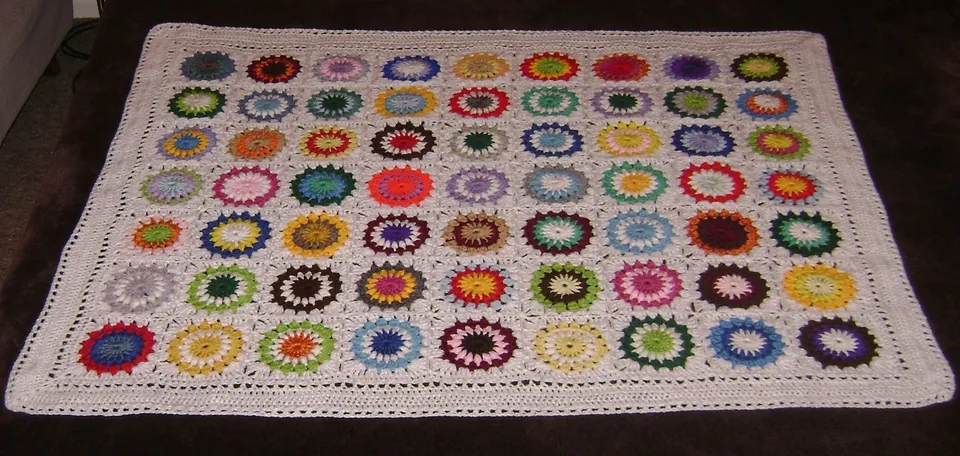
About This Generator
The Sunburst Granny Square Generator plans a puff-and-cluster center that becomes a four-corner square. Its purpose is to expose the construction behind the familiar radiating texture: center posts support puffs, spacing gaps support clusters, and the final circular ring supports a shaped square frame. It is suitable for crocheters comfortable with joining rounds and identifying completed stitch tops. A beginner can use it as a guided study after practicing a puff and a cluster separately.
How to Use This Generator
Set Square border rounds to the frame depth you want after the center. Center repeats accepts 8, 12, or 16; this is the number of repeated center units, not the final square's side length. Drawn-up puff loops changes the supported puff construction, Partial posts per cluster changes the cluster, and Puff spacing chains controls the gaps between puffs. Corner chains sets the frame's corner openings. Keep the first trial at the displayed defaults so that you can learn the sequence before modifying several structural variables together.
Choose your swatches in the desired round sequence and select US or UK terms. Generate, then follow Written Pattern through the center before studying the frame in Symbol Chart. The structure view helps locate shared bases but does not predict puff fullness in your yarn. Save project keeps a local draft. Export JSON preserves the center and corner parameters; Export SVG preserves the drawing. Print provides the instructions and diagram for working away from the screen, including the browser's option to save a PDF.
Understanding the Crochet Pattern
A puff and a cluster both close several loops into one completed unit, but their internal operations differ. Drawn-up puff loops refer to repeated loop-building actions, not a count of separate top stitches. A cluster uses partial posts that are closed together at the end. Securing chains and spacing chains can have different jobs: one closes a unit, while another establishes the next receiving gap. During squaring, taller stitches reach the corners and shorter stitches fill the sides. This variation changes height without inventing extra corners.
How the Generator Works
The engine builds the selected number of center posts, places a puff on each support, then places a cluster in each designated spacing gap. The square-forming round distributes these gaps into four sectors. Its stitch heights vary within the sector to turn a circular source into a square outline. Later frame rounds use corner groups and side groups, increasing the actual post total by twelve per extra square round. The drawing retains source relationships and the distinction between completed units and partial posts. Valid numeric ranges and repeat choices are checked before generation; arbitrary center counts are not silently approximated.
Step-by-Step Worked Example
Use 16 center repeats, 3 drawn-up puff loops, 4 partial posts per cluster, 1 puff spacing chain, 2 corner chains, and 1 square border round. Round 1 contains sixteen dc in the starting ring. Round 2 produces sixteen completed puffs, and Round 3 produces sixteen completed clusters with their spacing openings. The squaring round contains 60 actual posts: twenty-four tr at the corners, twenty-four dc, and twelve hdc between them. Four corner spaces are additional to those posts. Joining slip stitches and uncounted starting chains do not turn that total into sixty-four posts.
Download this worked example as JSON. Restore it in this generator to compare the actual counts and structure.
Practical Tips
Use yarn with enough stitch definition to distinguish the cluster closure from its spacing arch. Practice pulling puff loops to a consistent height; unequal loops can distort the center even when the count is correct. Change one structural setting at a time and keep the exported project with the finished swatch. When making a set of blocks, compare blocked outer edge lengths before joining rather than assuming identical puff counts guarantee identical dimensions.
Common Mistakes and Solutions
The puff ring feels much tighter than the foundation
The drawn-up loops may be too short or the spacing chains too tight. Check the intended loop-building steps, compare neighboring puffs, and remake a small center with more consistent loop height before increasing the frame size.
The next round enters the wrong opening
A securing chain may have been mistaken for a spacing gap. Identify the complete closed puff, locate its designated following space in the chart, and mark several receiving spaces before continuing.
The square has bowed or uneven sides
Check the taller corner groups and the shorter side groups first. Count four corners, compare opposite sectors, and verify all center gaps were consumed once. Blocking cannot reliably repair a missing side group.
Second Reproducible Application
Use this comparison to check how one input changes the sunburst granny square generator output. Enter rounds = 2; sunPoints = 16; puffLoops = 3; clusterPosts = 4; puffSpacing = 1; cornerChains = 2. Keep any grid and color data from the downloadable worked example unchanged. Generate again and compare the result with the first example above. The resulting dimensions are 5 rounds; widest round 72 stitches. These depend on the entered block size, not a measured finished sample. This comparison was executed with the site's engine; it is a numerical construction check rather than a claim about physical gauge. Save both settings separately if you want to compare them later.
Related Tools and Guides
The Tools directory at /generators/ lists the available generators. Use the linked examples on this page to study the same construction with different inputs, and the Guides directory at /guides/ for supporting reading. Check terminology and measured gauge before combining output from different tools.
Frequently Asked Questions
Why are the first three totals all sixteen?
They refer to different completed objects: initial posts, puffs, and clusters. Each stage has sixteen supports or completed units, while chains and partial internal posts are described separately.
Can I change the puff-loop count without changing the center repeats?
Yes, within the supported range. That changes the construction and likely fullness of each puff, while the number of repeated center units remains the selected repeat count.
What does Square border rounds count?
It controls the square frame after the center sequence. It is not simply the total number of all working rounds from the magic ring.
Does UK terminology change the geometry?
No. The output names change, such as US dc becoming UK tr, while the underlying source positions and generated counts remain the same.
Is a larger center guaranteed to lie flat?
No. The generator verifies its discrete construction rules, not the behavior of every yarn and tension. Make and finish a trial block before using it in a large project.